
Start here
Phone or computer: which to make your first game for
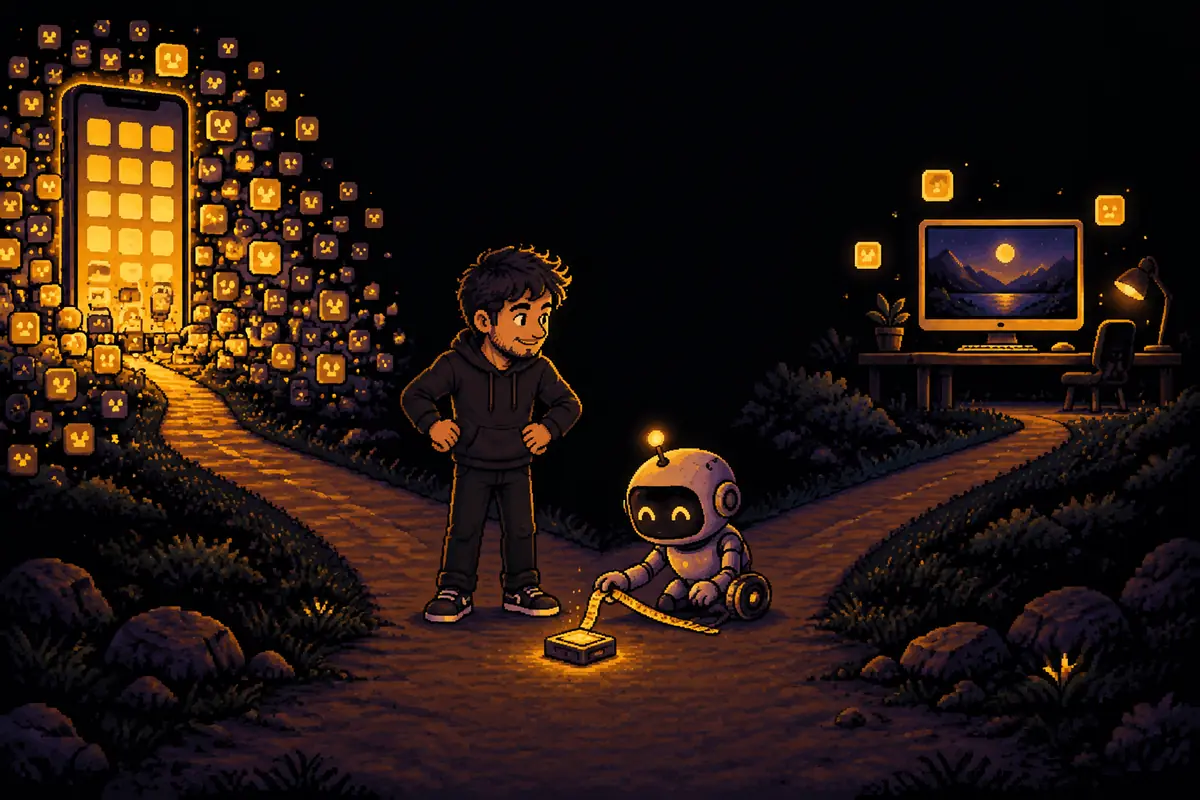
You picture your game on the living room TV. The biggest market is on another device, and what decides your first game is something else.
SUMMARY FOR WHEN YOU'RE SHORT ON TIME · 2 min
Make your first game for the device where a small game gets finished sooner, not for the biggest market. Phones move more money, $121.1 billion in 2026 by Newzoo's forecast, but that is where competition is fiercest. Computers have a free way in, such as itch.io. And a game made in Godot can come out on both.
- By Newzoo's forecast, mobile games should move $121.1 billion in 2026, more than console ($46.9 billion) and computer ($45.9 billion) combined.
- In Brazil, the phone is the favorite device of 44.1% of people who play, according to the Pesquisa Game Brasil 2026 survey; the computer, of 21.1%.
- Competition on phones grows faster than the money: 181,000 mobile games were released in six months, through May 2026.
- Publishing on Android costs $25 one time; on iPhone, $99 a year and a Mac; on Steam, $100 per game; on itch.io, there is no fee to use it.
- A new personal Google Play account needs a test with 12 people for 14 days in a row before launching.
- In Godot, a free program for making games, the same project can produce the phone version, the computer version, and the browser version.
- For a first game, the size of the game matters more than the size of the market (our reading).
Your first step: Write down which system your phone and your computer use (Android, iPhone, Windows, or Mac) and cross off the stores where you can't publish yet with what you have.
Which device should your first game be for, phone or computer?
The one where a small game gets finished sooner. The phone is the biggest games market in the world, and it is also where competition is fiercest. Computers have stores with a free way in. And for anyone using Godot, a free program for making games, the same project can become a phone version and a computer version.
This page is about the device the game will be played on, and the store it will go into. If your question is whether you can make the game using only your phone, the answer is in can you make a game with AI using only your phone.
| Phone | Computer | |
|---|---|---|
| Market size in 2026 (Newzoo forecast) | $121.1 billion1 | $45.9 billion1 |
| Favorite device of people who play in Brazil (Pesquisa Game Brasil 2026) | 44.1%2 | 21.1%2 |
| Cheapest store to start | Google Play: $25, one time6 | itch.io: no fee to use it10 |
| What the cheapest store also asks | New personal account: 12 testers for 14 days in a row7 | You choose how much of the sales goes to the site10 |
| How it is played | Tapping the screen | With keyboard, mouse, or controller |
Prices as of October 2026.
Think of someone who grew up playing on the living room TV, controller in hand. When they picture their own game, that is where it shows up. But players and money moved to the device in your pocket, and that is also where the line of new games grows fastest. So the question that decides a first game is a different one: what size of game you can finish, and on which device it gets done first (our reading).
Where is the money in games today?
On phones, by a wide margin. Newzoo, a company that tracks the games market, forecasts that the world will spend $213.9 billion on games in 2026, up 6.1% in a year1. Of that total, $121.1 billion is mobile games, more than half1.
Console gets $46.9 billion and computers $45.9 billion1. Together they add up to $92.8 billion: less than phones alone (our math).
In number of people, the gap is even bigger. By the same forecast, 3.7 billion people play in the world; 3.1 billion play on phones, 977 million on computers, and about 651 million on consoles1. One person can play on more than one device, so the parts add up to more than the total.
By the numbers
| Data | Number | Source and date |
|---|---|---|
| Global games market in 2026 | $213.9 billion (forecast) | Newzoo, via GamesBeat, August 25, 20261 |
| Mobile games | $121.1 billion (forecast) | Newzoo, via GamesBeat, August 25, 20261 |
| Console games | $46.9 billion (forecast) | Newzoo, via GamesBeat, August 25, 20261 |
| Computer games | $45.9 billion (forecast) | Newzoo, via GamesBeat, August 25, 20261 |
| People who play on phones | 3.1 billion, 84% of players | Newzoo, via GamesBeat, August 25, 20261 |
| People who play on computers | 977 million, 26% of players | Newzoo, via GamesBeat, August 25, 20261 |
| Prefer the phone, in Brazil | 44.1% | Pesquisa Game Brasil 2026, via Meio & Mensagem, April 9, 20262 |
| Mobile games released in six months, through May 2026 | 181,000 | ATTN Economy, via Digital Today, July 2, 20264 |
These numbers have two limits. They are a forecast, made in August 2026, and may be revised. And the size of the market is the sum of what all games sell: it doesn't say how much a new game will sell.
And in Brazil, which device do people play on?
Also the phone. In the Pesquisa Game Brasil 2026 survey, which heard from 7,115 people aged 16 to 55, the phone was the favorite device of 44.1% of people who play, console of 24%, and computer of 21.1%2. These are the people surveyed, not all Brazilians.
Among phones in Brazil, Android dominates. According to StatCounter, a company that measures system usage, in September 2026 Android had 78.78% of phone usage in Brazil, and iPhone 21.21%3.
That matters in one practical detail. Google Play, the Android store, requires a new personal account to test the game with at least 12 people for 14 days in a row before launching7. With Android close to four out of five in phone usage, finding those 12 among friends and relatives in Brazil tends to be easier (our reading).
If phones are the biggest market, why aren't they the obvious choice?
Because a big market attracts too many people, and the money stays with a few. 181,000 mobile games were released in six months, through May 2026, according to ATTN Economy, a research firm cited by Digital Today, a South Korean newspaper4. In one year, releases rose 118% on iPhone and 73% on Android, and the report ties this rise to AIs that write code4.
The money didn't keep up. According to Naavik, which analyzes the games market, the number of games that reached $20,000 in revenue grew only 14% from December 2025 to February 20264. And the same ATTN Economy calculated that about 80% of app downloads in the world go to the top 1% of companies, which also take most of the revenue4. That figure is for apps in general, not only games.
How phones make money also matters. According to Sensor Tower, with data from 19 countries, the share of mobile games that make money from ads went from 45.1% in July 2021 to 55.6% in May 20265. A game that lives on ads needs a lot of people playing to earn anything, and your first game competes for that attention with games that already have millions of players (our reading).
On computers, the line is long too. On Steam, the biggest store for computer games, many new games are barely played: the numbers are in are there too many games already. Competition exists on both devices. What changes is its size.
What does each store cost and ask for?
Putting the game on phones costs from $25, and on computers it can cost nothing. The table shows the four most common ways in, with prices as of October 2026.
| Store | For which device | What it costs | What else it asks |
|---|---|---|---|
| Google Play | Android phone | $25, one time only6 | 18 or older, ID and card in your name if requested, confirming access to an Android phone6; new personal account: 12 testers for 14 days in a row7 |
| App Store | iPhone | $99 a year8 | A Mac with Xcode to prepare the game12 |
| Steam | Computer | $100 per game9 | For your first games, a 30-day wait between paying and launching9 |
| itch.io | Computer and browser | No fee to use it10 | You choose how much of the sales goes to the site10 |
Google Play is the cheapest way onto phones. The fee is for the developer account and is paid one time only6. What takes time is the test with 12 people. The whole path is in how to publish a game on Google Play.
iPhone costs every year and requires a Mac. Apple's developer program costs $99 a year8, and Godot's documentation says the iPhone version only comes from a computer running macOS with Xcode installed12.
Steam charges per game. It is $100 per game, which comes back in your payout once the game passes $1,000 in adjusted revenue9.
itch.io is the way in with no fee. itch.io is a games site where anyone can publish, and it charges nothing to use10. The person publishing chooses what share of sales goes to the site, in what it calls open revenue sharing10. It accepts games that run in the browser, with nothing to install11.
Do I have to pick only one device?
In the program, no; in your head, yes (our reading). Godot, the program where the game is built (what the field calls a game engine), has a button that produces, all at once, versions of the game for every device you have set up15. Each device needs extra tools installed15, and the iPhone one still requires a Mac12.
There is also a middle path: the browser game. It opens on a web page, without going through any store13. It runs on computers and, according to Godot's documentation, also on phones, with some caveats13. The version made for the device always runs better, by a significant margin, and the documentation recommends browsers such as Chrome or Firefox, because Safari, Apple's browser, has problems with the graphics part these games use13. On itch.io, the person publishing marks whether the game works on phones11.
But a game designed for a finger and a game designed for a keyboard differ in controls, button size, and screen orientation (our reading). It can come out on both, but the game turns out better when it is designed for one of them first.
What kind of game fits each device?
On phones, simple touch games and short rounds; on computers, games that call for keyboard, mouse, and more time sitting down. This is our reading, based on how each device is used, not a store rule.
- Phone: one hand only, tap or swipe, upright screen, rounds of a few minutes that fit in a line at the bank. Puzzles, one-touch games, and endless runners.
- Computer: two controls at once (walk and jump, aim and shoot), big screen, longer rounds. Obstacle-jumping games, strategy games, and story games.
Notice that the simplest types to make live, to a large extent, on phones (our reading). Examples of each, with what they require, are in what your first game should be.
Does the device you already have change the choice?
It does, a lot. With a Windows computer, you can make games for Android, for the browser, and for Steam; for iPhone, no, because the iPhone version only comes from a Mac12.
Your phone counts too. To test an Android game, Godot sends the game to a phone connected to the computer by cable, or over Wi-Fi, with one click; a browser game opens right in the computer's browser14. And Google Play requires a new personal account to confirm access to an Android phone, through the Play Console app6.
In practice: someone with a Windows computer and an Android phone has the Android, browser, and Steam doors open without buying another device (our reading). Someone with only an iPhone and Windows can start with the browser or the computer, and leave iPhone for when they have a Mac. To find out whether your machine can handle it, see whether your computer is good enough to make games.
So, where do you start?
With the size of the game, and then the device. A one-screen game that you can finish teaches more than a huge game stuck halfway, on any device (our reading).
With the small game defined, the choice usually falls into one of these cases:
- You have an Android phone and know 12 people with Android: phone, through Google Play, counting on the 14 days of testing.
- You want to show the game soon, without paying a fee: browser, through itch.io, which opens on computers and, with caveats, on phones.
- You dream of Steam: computer, knowing about the $100 per game and the 30-day wait.
- You want iPhone: only with a Mac and $99 a year.
The living room TV can wait. The right device for a first game is the one where it reaches the end.
The other side
None of these numbers says how much your game will earn. Phones are the biggest market, but their money stays with a few games and a few companies, and the line of releases grows faster than the line of games that make money. Newzoo's numbers are a forecast. A browser game runs worse on a phone than the version made for it. Stores change fees and rules from time to time. And picking the right device doesn't make anyone find your game: no one can promise you will get rich.
Your action plan
Check off what you've done. It's saved on this device, so you can pick up where you left off.
Related questions
Do mobile games make more money than computer games?
The mobile market is bigger: $121.1 billion versus $45.9 billion for computers in 2026, by Newzoo's forecast. But that is the sum of all games, and the money is concentrated in a few. It doesn't say how much a new game will earn.
Can you make a game that runs on both phone and computer?
Yes. In Godot, the same project can produce a version for each device, and the browser version opens on both, with caveats on phones. What changes are the controls: tapping the screen and using a keyboard call for adjustments to the game.
Do I need a Mac to make a mobile game?
Only for iPhone. Godot's documentation says the iPhone version comes from a computer running macOS with Xcode. For Android, a Windows computer works.
What is the cheapest store for a first game?
itch.io charges nothing to use, and the person publishing chooses how much of the sales goes to the site. Among phone stores, Google Play is the cheapest: $25, paid one time. Prices as of October 2026.
Do browser games work on phones?
They work with caveats. Godot's documentation warns that a browser game runs slower on a phone than the version made for the device, and recommends browsers such as Chrome or Firefox. On itch.io, the person publishing marks whether the game works on phones.
How many people do I need to launch a game on Google Play?
If the account is personal and was created after November 13, 2023, at least 12 testers opted in for 14 days in a row before you apply to publish.
Can I make the game using only my phone?
That is a different question: this page is about the device the game will be played on. Making the game from your phone works in part, by directing the AI that works on a computer or in the cloud.
Sources
- GamesBeat, "Global players could reach 4 billion by 2029" (Newzoo, forecast for 2026, August 25, 2026). Accessed October 15, 2026.
- Meio & Mensagem, Pesquisa Game Brasil 2026 (April 9, 2026). Accessed October 15, 2026.
- StatCounter, mobile operating systems in Brazil (September 2026). Accessed October 15, 2026.
- Digital Today, "AI vibe coding spurs surge in mobile game releases" (July 2, 2026). Accessed October 15, 2026.
- Game World Observer, mobile game ad revenue in 2025 (Sensor Tower data, July 6, 2026). Accessed October 15, 2026.
- Play Console Help, "Get started with Play Console" (sign-up and fee). Accessed October 15, 2026.
- Play Console Help, testing requirement for new personal accounts. Accessed October 15, 2026.
- Apple Developer, what's included in the program (prices as of October 2026). Accessed October 15, 2026.
- Steamworks, Steam Direct. Accessed October 15, 2026.
- itch.io, frequently asked questions for creators. Accessed October 15, 2026.
- itch.io, HTML5 games guide (browser). Accessed October 15, 2026.
- Godot documentation, exporting for iOS. Accessed October 15, 2026.
- Godot documentation, exporting for the web. Accessed October 15, 2026.
- Godot documentation, "One-click deploy". Accessed October 15, 2026.
- Godot documentation, "Exporting projects". Accessed October 15, 2026.
Was this article helpful?
Thank you. This helps us decide what to improve.
Once a week, what changed in making games with AI
Every Tuesday, a 3 to 5 minute read: the news that changes something for people who want to make a game, one reader question answered, and the new articles. Unsubscribe anytime with one click.
By signing up, you agree to the privacy policy.
Done. We sent you an email to confirm.
That didn't work. Check that your email is correct and try again.
Found a mistake? Let us know. We fix it and log the correction on the page. Report a mistake