
Publishing
How do free games make money? The three ways
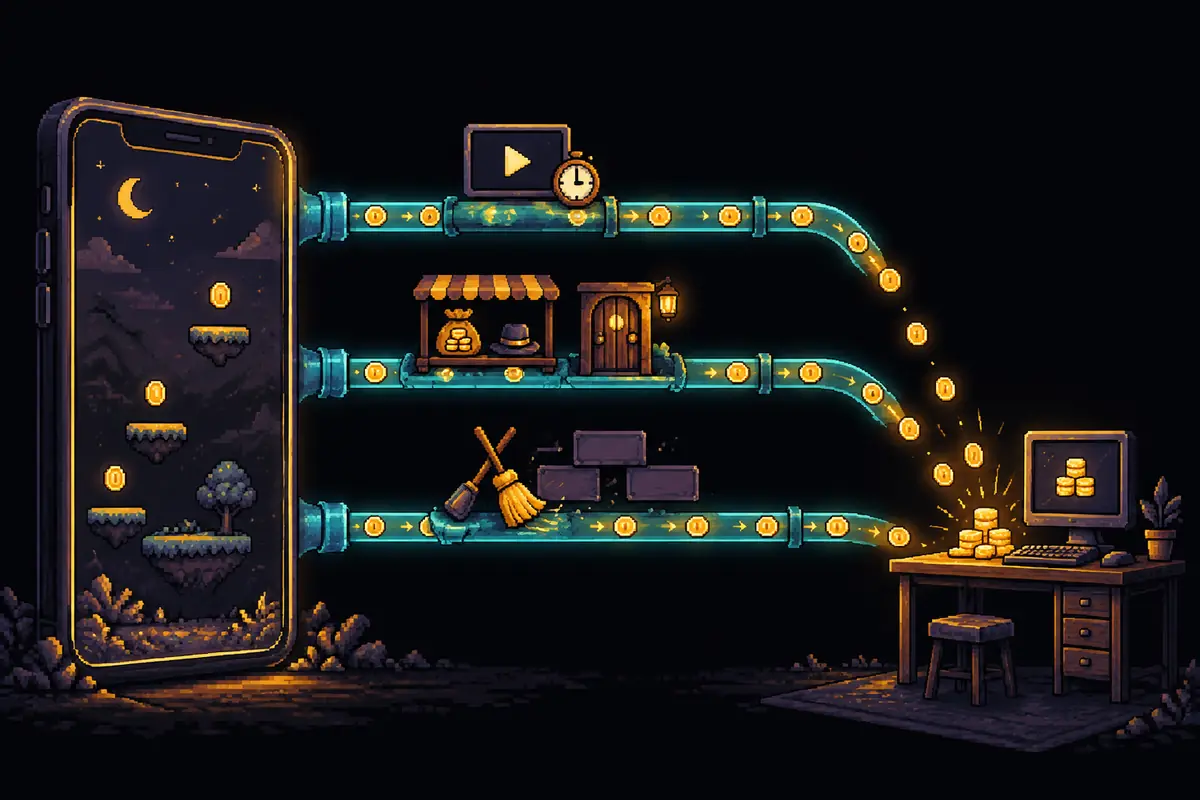
Free games make money in three ways. You have already paid for at least one of them, even without spending a cent.

SUMMARY FOR WHEN YOU'RE SHORT ON TIME · 2 min
A free game makes money in three ways: ads, like the video you watch to get an extra life; purchases inside the game, like coins or outfits for your character; and a paid ad-free version. One game can use all three. In mobile games, purchases bring in more money, but most of it stays with a few companies.
- A rewarded ad only shows up when the player chooses to watch it, and the reward is usually an extra life or in-game coins, according to AdMob, Google's ad network.
- On Google Play, coins, extra lives, characters, and the ad-free version sold inside the game must go through the store's payment system.
- Outside the United States, Europe, the UK, Japan, and Australia, Google Play keeps 15% of sales up to $1 million a year for developers in the 15% tier (October 2026).
- On Apple's App Store, the program for small developers charges 15% to those who earn up to $1 million a year.
- Purchases inside mobile games came close to $82 billion in 2025, according to Sensor Tower.
- Ads in mobile games passed $12 billion in 2025, across 19 countries, according to Sensor Tower data.
- In the first half of 2022, 1% of mobile game companies took 93% of the money spent on games, according to Sensor Tower.
Your first step: Open three free games you have on your phone and write down which of the three ways each one uses to make money.
How does a free game make money?
In three ways: ads, purchases inside the game, and a paid version without ads. The game is free to download, and the money comes in later, while people play. In the industry, the way a game makes money is called monetization.
| Way | Who pays | What the player gets | Example |
|---|---|---|---|
| 1. Ad | The advertiser | An extra life, coins, or just to keep playing | The video after "game over" |
| 2. In-game purchase | The player | An item, an advantage, a level | Coins, an outfit for the character |
| 3. Ad-free version | The player | Playing without interruptions | A payment to remove the ads |
One game can use all three. The Google Play Payments policy, for the Android store, lists in-game coins, extra lives, characters, and "an ad-free version" side by side as things an app can sell3.
The numbers show where the money is, and the end of this page shows who keeps it. No one can promise that you will get rich from a game, free or paid.
Who pays when you watch an ad to get an extra life?
The advertiser. You pay with your time, and the advertiser pays with money.
Picture the scene. You lose your last life in a phone game. A button appears: watch a video and keep playing. You tap it, wait a few seconds, and go back to the game. You didn't spend anything, but someone got paid for it.
Here is the path: the company that wants to be seen pays an ad network, and the network shows the video inside games and splits the money with whoever made the game. AdMob, Google's ad network for apps, says it lets publishers earn money from the ads shown in their apps2. How much goes to each side, the page doesn't say.
The ad you choose to watch has a name: a rewarded ad. According to AdMob Help, it only shows up after the player chooses to watch it, and the reward is usually something like an extra life or in-game coins1. Apple also allows a game to offer a reward for watching an ad5.
There are other formats, like the ad that pops up on its own between levels. Under Apple's rules, this kind must make clear that it is an ad and have a close button that is easy to find and tap5.
What is an in-game purchase?
It is when the game is free to download and sells things inside it: coins, extra lives, more playtime, characters, outfits for the character3. In the industry, this is called an in-app purchase.
On the two big phone stores, these sales go through the store's own payment system. Google Play requires its system for items like in-game coins, extra lives, extra playtime, characters, and avatars, with exceptions in some countries3. Apple requires purchases through its system to unlock in-game currencies, levels, premium content, or the full version5.
Apple adds two rules worth knowing before you sell coins. Coins bought inside the game can't expire. And the game must have a way for the player to restore what they bought, when the purchase is the kind that can be restored5.
One type of purchase calls for extra care: the random reward box, known in the industry as a loot box. You pay without knowing what is inside. Google Play and Apple require the game to show the odds of getting each item before the purchase35.
How does the ad-free version work?
The player pays once, or subscribes, to play without ads. The game stays the same, just without interruptions.
On Google Play, "an ad-free version" of an app appears in the policy as one of the examples of things sold through the store's payment system3. In our reading, it is the easiest of the three to understand: someone who likes the game and is tired of the videos has a clear reason to pay.
If the ad-free version is a subscription, Apple asks that it last at least seven days and that the game clearly say what the player gets for the price5.
Which of the three ways brings in the most money?
Purchases inside the game. In mobile games, they came close to $82 billion in 2025, up 1.3% from the year before, according to Sensor Tower, a company that measures the app market7. Ads in mobile games passed $12 billion that same year, according to data from the same company published by the site Game World Observer8.
The two numbers come from different studies. The ad figure covers 19 countries, Brazil among them, not the whole world8. So they show the order of magnitude, and they shouldn't be compared one against the other.
| In numbers | Value | Source and date |
|---|---|---|
| Purchases inside mobile games, 2025 | Close to $82 billion (+1.3%) | Sensor Tower, State of Mobile 20267 |
| Ads in mobile games, 2025, in 19 countries | Over $12 billion | Sensor Tower, via Game World Observer, July 20268 |
| Games that use ads to make money | 45.1% in July 2021; 55.6% in May 2026 | Sensor Tower, via Game World Observer8 |
| Share of ad money that goes to puzzle games | 53%, from February to April 2026 | Sensor Tower, via Game World Observer8 |
| Share of mobile game spending taken by 1% of companies | 93%, in the first half of 2022 | Sensor Tower9 |
Ads have been gaining ground. The share of games that make money from ads went from 45.1% in July 2021 to 55.6% in May 2026, according to the same report, at a time when purchases inside games have stalled8. Puzzle games took 53% of the ad money in mobile games between February and April 20268.
In our reading, this helps explain why so many simple phone games show ads: it is a way to make money that doesn't depend on the player opening their wallet.
How much does the store keep from each purchase?
A share of every sale made through the store's payment system, and that share changes with the store and with where the buyer is. Figures as of October 2026.
On Google Play, the rule changed in 2026 in five places: the European Economic Area, the UK, and the United States since June 30, and Australia and Japan since September 304. Everywhere else, until the new rule arrives, the old one applies: for developers in the 15% tier, the store keeps 15% up to $1 million a year and 30% on anything above that; on subscriptions, 15%4. Brazil is not among the five places listed.
| Store and situation | What the store keeps | Source |
|---|---|---|
| Google Play, outside the five places with the new rule, 15% tier | 15% up to $1 million a year; 30% above that | Google Play4 |
| Google Play, outside the five places, subscriptions | 15% | Google Play4 |
| Google Play, US, Europe, UK, Japan, and Australia, new install | 20% plus 5% for payment, up to $1 million a year | Google Play4 |
| App Store, small developer program | 15% on paid games and in-app purchases, for those earning up to $1 million a year | Apple6 |
On the App Store, anyone who goes over $1 million in a year leaves the program and goes back to Apple's standard rate6.
Google itself says, on the fees page, that 97% of developers distribute their apps on the store without paying a service fee4. Our reading: the fee only shows up when the app sells something through the store, and most apps don't sell anything there.
An example calculation, for the order of magnitude: if a player in Brazil spends the equivalent of $1 on a purchase inside the game, 15 cents go to Google Play. What is left still isn't profit: taxes and your own costs come out of it. The fees page covers what is sold through the store's payment system; ad money follows the ad network's split2.
What rules do the stores and ad networks set?
Several, and breaking one can get the game pulled from the store or the ad account closed. The main ones, in the pages we read:
- Don't click your own ads. AdMob forbids publishers from clicking the ads in their own game, even to test them, and says it analyzes every click and impression2.
- Show the odds of the random box. Before the purchase, on both stores35.
- Bought coins don't expire. An Apple rule5.
- Ads that interrupt must be easy to close. Also from Apple, which also asks for a way for players to report inappropriate ads inside the game5.
- Games made for kids. Apple says apps made mainly for kids should not include ads from other companies5.
There is one more detail that links ads to the game's store page: ad networks collect data from players, and that goes into Google Play's data safety form. It is explained in how to publish a game on Google Play.
Which way should you pick for your first game?
No data shows which of the three earns more for a new game, and be wary of anyone who says there is. What you can decide is what fits in your first game.
In our reading, one simple way is the most sensible choice at the start. Each way adds work: ads need an account with a network and care with its rules; in-game purchases need a small shop, prices, and the store's payment system; a random box needs the odds shown. A small, finished game teaches more than a big game full of shops. The kinds of games that fit a first project are in what should your first game be.
It is also worth looking at the player's side. Apple asks that players get what they paid for without extra tasks, and it removes apps that try to trick people into subscribing5. In our reading, a game that only works if the player pays or watches ads all the time pushes away exactly the people who would like to stay.
Does every free game make money?
No. Most of the money stays with a few companies. In the first half of 2022, the top 460 companies, 1% of those with revenue, took 93% of mobile game spending, about $27 billion, according to Sensor Tower. The rest, close to 46,000, split the remaining 7%, about $2 billion9.

The data is from 2022, the most recent of its kind we found published by Sensor Tower itself, and it counts companies, not games. Even so, it shows the shape of the market: the big numbers at the top of this page are the sum of everyone, and almost all of that money stays at the top.
The same goes beyond phones. On Steam, the biggest store for computer games, most games also earn little, as shown in how much a game makes on Steam. And the competition for attention is fierce, which is covered in too many games already?.
The other side
Knowing how a free game makes money doesn't tell you how much a new game will make. The billions on this page belong to the whole market, and most of it stays with a few companies. In our reading, ads only pay off with lots of people playing, and in-game purchases only pay off if someone wants to buy. Store fees and rules change: Google Play changed its fees in five places in 2026 alone. And whatever comes in still pays the store, taxes, and your own costs. No one can promise that you will get rich from a game.
Your action plan
Check off what you've done. It's saved on this device, so you can pick up where you left off.
Related questions
Do free games make money?
They can, through ads, purchases inside the game, or an ad-free version. But the money is concentrated: in the first half of 2022, 1% of mobile game companies took 93% of spending, according to Sensor Tower. No one can promise that a new game will earn anything.
Who pays when I watch an ad in a game?
The advertiser pays the ad network, and the network passes a share on to whoever made the game. The player pays with the time spent watching. AdMob, Google's network, says it lets publishers earn money from ads inside their apps.
What is an in-game purchase?
It is when the game is free to download and sells things inside it: coins, extra lives, characters, outfits, levels. On Google Play and the App Store, these sales go through the store's payment system.
How much does the store keep from each in-game purchase?
On Google Play, outside the five places with the new 2026 rule (the United States, the European Economic Area, the UK, Japan, and Australia), 15% up to $1 million a year for developers in that tier. On the App Store, 15% for those in the small developer program. Figures as of October 2026.
Do I have to pay anything to put ads in my game?
The AdMob pages we read don't mention a fee to join. What they do list are rules: for example, publishers can't click on their own ads, not even to test them.
What is a loot box and what do the stores require?
A loot box is a random reward box: you pay without knowing what is inside. Google Play and the App Store require the game to show the odds of getting each item before the purchase.
Which of the three ways is best for a first game?
No data shows which one earns more for a new game. In our reading, a first game is better off with one simple way, because each one adds work, rules, and forms.
Sources
- AdMob Help, rewarded ads. Accessed October 15, 2026.
- AdMob Help, AdMob program policies. Accessed October 15, 2026.
- Play Console Help, Google Play Payments policy. Accessed October 15, 2026.
- Play Console Help, service fees. Accessed October 15, 2026.
- Apple, "App Store Review Guidelines" (rules 3.1.1, 3.1.2, and 3.2.2). Accessed October 15, 2026.
- Apple, "App Store Small Business Program". Accessed October 15, 2026.
- Sensor Tower, "State of Mobile 2026". Accessed October 15, 2026.
- Game World Observer, "In 2025, mobile game advertising revenue exceeded $12 billion" (July 6, 2026, Sensor Tower data). Accessed October 15, 2026.
- Sensor Tower, study of the top 1% of companies, first half of 2022. Accessed October 15, 2026.
Was this article helpful?
Thank you. This helps us decide what to improve.
Once a week, what changed in making games with AI
Every Tuesday, a 3 to 5 minute read: the news that changes something for people who want to make a game, one reader question answered, and the new articles. Unsubscribe anytime with one click.
By signing up, you agree to the privacy policy.
Done. We sent you an email to confirm.
That didn't work. Check that your email is correct and try again.
Found a mistake? Let us know. We fix it and log the correction on the page. Report a mistake