
Stories
Gunpoint: the journalist who made a game with $30
He wrote about games for a magazine and had never programmed. He bought a $30 program, took about three years and left the magazine to make games.
SUMMARY FOR WHEN YOU'RE SHORT ON TIME · 2 min
Gunpoint is a spy game released in 2013 by Tom Francis, who wrote for PC Gamer magazine and had no programming background. He made the game in his spare time with Game Maker 8, a $30 program, and brought in artists and musicians. It took about three years, without AI, and his case is an exception.
- Tom Francis was an editor at PC Gamer magazine, in the UK, and had no programming background, according to Wikipedia.
- In May 2010, he announced on his own blog that he was going to make a game, and described himself as someone with no time and no experience.
- The tool was Game Maker 8, a game-making program that cost $30, the game's only direct cost, according to him.
- The art came from two artists and the music from three musicians, whom he recruited through his blog.
- Gunpoint came out on June 3, 2013, about three years after it began (our math).
- According to the author, the $30 came back 64 seconds after pre-orders opened, and he left the magazine to make games.
- In October 2026, 97% of the 8,238 English reviews on Steam were positive.
Your first step: Write one sentence about what you would change in a game you like, the way Tom Francis did in the reviews he wrote, and keep that sentence as the seed of your game.
Who is Tom Francis?
Tom Francis is the creator of Gunpoint, and when he started the game he wrote about games: he was an editor at PC Gamer, a PC games magazine in the UK1. He had no programming background1.
What he did have was years of reviews. In them, he kept suggesting how a game could be better, and the idea for Gunpoint grew out of that habit1. Wanting to make his own game was not new: he wrote that he had wanted to do it for most of his adult life2.
How did a journalist with no experience start a game?
He started with one less excuse. In May 2010, Tom Francis wrote on his blog that Spelunky, one of his favorite games, had been made by one person, in a program called Game Maker2. For him, that removed the last excuse not to try2.
In the same post, he described himself as someone with "little time, less talent and no experience"2. He even opened Spelunky's code to learn from it, and found it too hard for him2. He predicted that just getting the character to move well would take about six months2.
The program he chose was Game Maker 8, a game-making program that cost $301. It was the game's only direct cost, according to him3. Within about a month, there was already a first playable version, which he showed on his blog1.
Did he make the game alone?
No. The code and the game design (the rules, the levels) were his, but the art and music came from outside1. In 2011, he asked artists on his blog to send samples, got far more than he expected and picked two: John Roberts and Fabian van Dommelen1. The music came from three musicians recruited the same way: Ryan Ike, Francisco Cerda and John Robert Matz1.
All of this happened in his spare time, while he kept working at the magazine1. The game came out on June 3, 2013, for PC1. From the blog announcement to the release, it was about three years (our math).
How do you play Gunpoint?
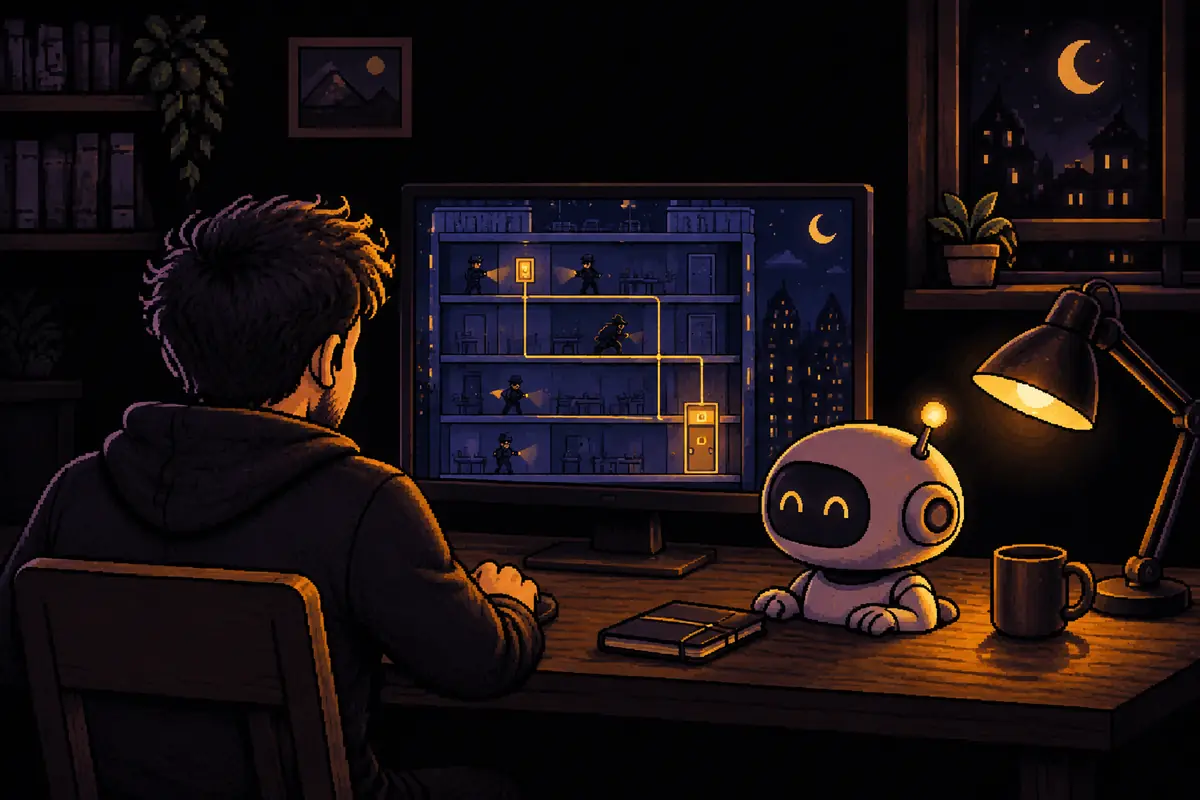
You are a freelance spy who breaks into buildings to steal information14. The building is shown cut in half, like a dollhouse, with its floors, guards and wires in plain view.
The main tool is the Crosslink, a gadget that shows the building's circuits and lets you rewire one object to another1. A light switch now opens a locked door; or it opens a trapdoor, and the guard who goes to turn on the light falls to the floor below4.
The fun is in that swap: the game gives you the pieces and you invent the way out. Guards carry guns, and being seen means instant death, a choice the author made so the guns would be taken seriously1. At the end of each mission, you are graded on time, noise and how many times you were seen1. The game also comes with a level editor1.
Did the game succeed?
It did, according to the author and the critics. Tom Francis said the $30 for the program came back 64 seconds after pre-orders opened; counting promotion and contracts, the cost came back within a few hours3. Pre-orders beat his expectations, and he left the magazine to make games full time3.
Critics liked it: the Metacritic average, a site that collects magazine scores, was 83 out of 1001. PC Gamer itself did not publish a score, to avoid a conflict of interest1. In October 2026, 97% of the 8,238 English reviews on Steam, the largest PC game store, were positive4.
Then came Heat Signature, in 2017, and Tactical Breach Wizards, in 2024, from his studio, Suspicious Developments1. In 2015, he released a video series to teach people who had never made a game how to start, with the same kind of program he had used5.
By the numbers
| Data | Value | Source |
|---|---|---|
| Start of the game | May 2010 | Pentadact, 05/03/20102 |
| Cost of the tool | $30, Game Maker 8, the only direct cost | Pentadact, 06/18/20133 |
| Team | The author, two artists and three musicians | Wikipedia1 |
| Release | June 3, 2013, for PC | Wikipedia1 |
| Time to release | About three years (our math) | Wikipedia1 |
| Time to recoup the $30 | 64 seconds of pre-orders, according to the author | Pentadact, 06/18/20133 |
| Critics' average | 83 out of 100 on Metacritic | Wikipedia1 |
| Steam reviews | 97% positive, out of 8,238 in English (October 2026) | Steam4 |
What does the Gunpoint story show, and what doesn't it?
It shows that someone with no programming background made a well-reviewed game, with a cheap tool, in his spare time. It also shows that the idea came from what he knew best: years of playing and reviewing games (our reading).
The other side
Gunpoint does not prove it is fast or easy. It was about three years of work outside his working hours, and the game was not made alone: it had two artists and three musicians. Tom Francis already worked in games, knew the audience and had a blog read by people in the field, which helped him find the team and sell. He did not share sales figures in the sources we read. And it is the story of a game that worked, told precisely because it is rare: most games that are released sell little.
What has changed since then?
This part is not about Gunpoint, which was made without AI. It is about the work.
Tom Francis expected six months just to get the character moving properly, and he learned to code along the way2. Today, AI can do that part: you describe what you want and it writes the commands, which came to be called vibe coding. That does not make the work easy: testing, fixing and deciding are still up to you, and no one guarantees the result.
What AI does not bring is what he had plenty of: knowing what was missing in the games he liked (our reading). If you want to see other cases, read about people who made a game without being a programmer and the story of Masako Wakamiya, who made a game after 80. To understand the part that changed, see whether you can make a game without knowing how to code.
Related questions
Who made Gunpoint?
Tom Francis, who at the time was an editor at PC Gamer magazine, in the UK. He made the game in his spare time, with two artists and three musicians he recruited, and released it on June 3, 2013.
Did Tom Francis know how to code when he started?
He had no programming background. In the post where he announced the game, in May 2010, he said he had no experience. He learned by doing, with Game Maker 8.
How much did it cost to make Gunpoint?
The only direct cost was Game Maker 8, at $30, according to the author. Counting promotion and contracts, he said the total cost came back within a few hours of pre-orders.
How long did it take to make Gunpoint?
About three years, from May 2010 to June 2013 (our math), in his spare time, while he worked at the magazine. The game was made without AI.
How do you play Gunpoint?
You are a spy who breaks into buildings. With a gadget called the Crosslink, you link one object to another, like a light switch to a trapdoor, to get guards out of the way. If an armed guard sees you, the mission is over.
How many copies did Gunpoint sell?
The author did not share sales figures in the sources we read. He said pre-orders beat his expectations and that the money let him quit his job and make games full time.
Did Tom Francis make other games?
Yes. With the studio Suspicious Developments, he released Heat Signature in 2017 and Tactical Breach Wizards in 2024.
Sources
- Wikipedia, "Gunpoint (video game)" (cites Gamasutra, 01/21/2012, Ars Technica, 09/22/2011, and Engadget, 05/27/2013). Accessed October 25, 2026.
- Tom Francis, Pentadact blog, "Private Dick" (05/03/2010). Accessed October 25, 2026.
- Tom Francis, Pentadact blog, "Gunpoint Recoups Development Costs In 64 Seconds" (06/18/2013). Accessed October 25, 2026.
- Steam, official Gunpoint page. Accessed October 25, 2026.
- MCV, "VIDEO: Gunpoint dev Tom Francis teaches newcomers to make games" (01/07/2015). Accessed October 25, 2026.
Was this article helpful?
Thank you. This helps us decide what to improve.
Once a week, what changed in making games with AI
Every Tuesday, a 3 to 5 minute read: the news that changes something for people who want to make a game, one reader question answered, and the new articles. Unsubscribe anytime with one click.
By signing up, you agree to the privacy policy.
Done. We sent you an email to confirm.
That didn't work. Check that your email is correct and try again.
Found a mistake? Let us know. We fix it and log the correction on the page. Report a mistake