
Stories
The story of Angry Birds: Rovio's game number 52
A 12-person company, close to bankruptcy, had already made 51 games. The 52nd cost €100,000 and changed everything.
SUMMARY FOR WHEN YOU'RE SHORT ON TIME · 2 min
Angry Birds was the 52nd game from Rovio, a Finnish company that, in early 2009, was close to bankruptcy and had shrunk to 12 people. The team took about eight months, in spare time between contract jobs, and the game cost €100,000. It came out in December 2009 and was made without AI, by people who already made games.
- Rovio, from Finland, had made 51 games before Angry Birds, most of them contract work for companies like EA and Namco.
- In early 2009, the company was close to bankruptcy and had dropped from 50 to 12 employees.
- In March 2009, a Rovio designer showed a drawing of round, angry birds; he had pitched hundreds of ideas in the two months before.
- The initial budget was €25,000, and the game ended up costing €100,000, made in spare time between jobs for other companies.
- The green pigs and the slingshot were not in the first version: they came later, through testing.
- The game came out in December 2009 and spent three months doing poorly in English-speaking countries before reaching number one in the United States, in April.
- According to Rovio, Angry Birds was the first mobile game to pass 1 billion downloads, in 2012.
Your first step: Write three game ideas, one sentence each, and show them to someone today, like the Rovio designer did with his.
Why is Angry Birds game number 52?
Because Rovio, the Finnish company that made Angry Birds, had already made 51 games before it12. Most of them were contract work for big companies like EA and Namco, and some sold millions of copies for those clients1. The problem was that the success stayed with whoever ordered the game.
This is a "started small" story, and it is worth reading with three warnings:
- Angry Birds was not made with AI. It is from 2009.
- The people who made it already made games. It was a company with programmers and designers, not one person alone.
- It is a case that worked out. Rovio itself went through 51 games without a hit of its own, and most game companies never get one.
How do you play Angry Birds?
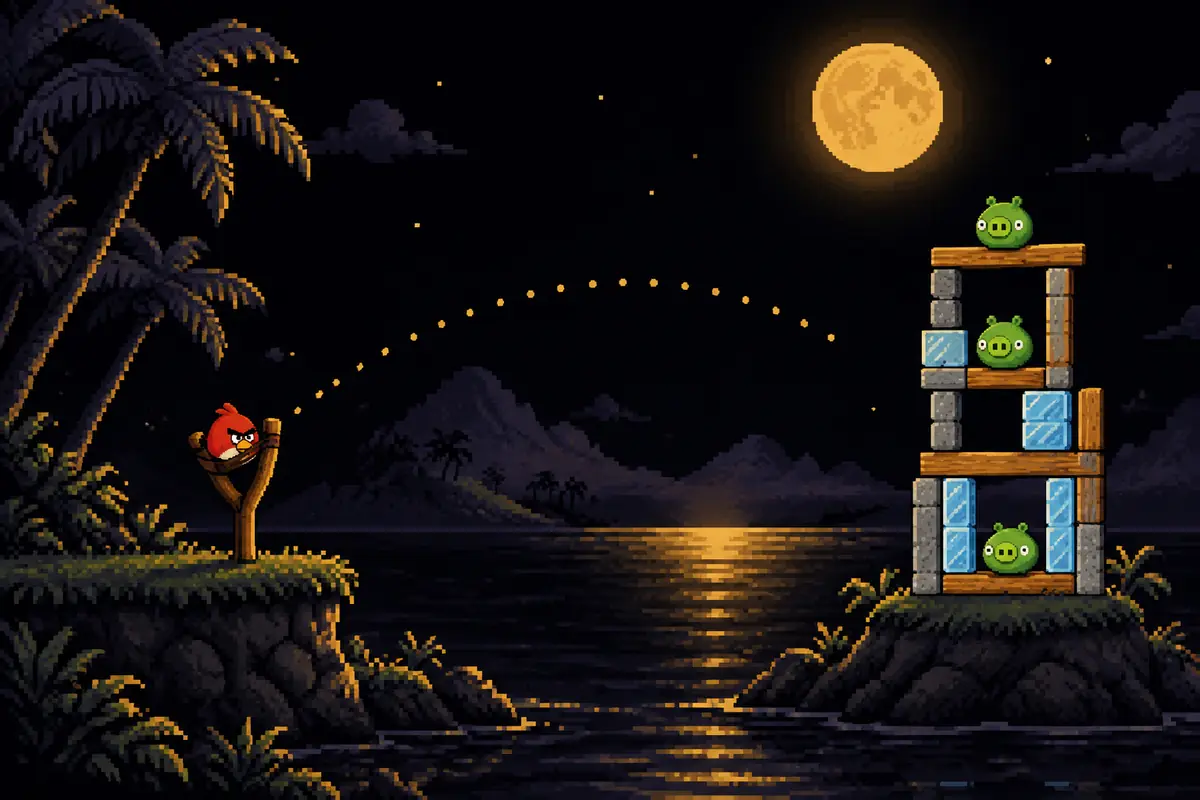
You pull a slingshot with your finger, choose the power and the angle, and let go1. The bird flies into structures of wood, stone and ice where green pigs are hiding. The story fits in one sentence: the pigs stole the birds' eggs1.
The fun is in the physics, the way things fall on screen as they would in real life. A tower that wobbles, a plank that slides, a pig that only falls on the third try. According to the game's designer, every level has one key shot to land, and two layers: finishing the level with one star, for casual play, and getting three stars, for people who want to dig in1. He said he designed the game so his mother could enjoy it, and so could he1.
Who created Angry Birds?
Rovio belongs to cousins Niklas and Mikael Hed1. Niklas had been programming since he was a boy: at 12, a childhood friend says, he was already making a ball move on the screen1. While studying computer science, in 2003, he and two friends won a game competition, and from that came a company called Relude, which later became Rovio, "bonfire" in Finnish12.
The idea for the birds came from Jaakko Iisalo, a Rovio designer since 20061. But the game was made by the company's team, while the company made other games to pay the bills.
How much did it cost and how long did it take?
About €100,000 and around eight months12. Mikael Hed set aside a budget of €25,000, and the final cost was four times that1.
It was not full-time work. The team worked on Angry Birds when there was time left over: in the six months of work on the game, Rovio delivered four other contract games1. In Niklas's words, Angry Birds was what they did whenever they had slack time1.
| In numbers | Value | Source and date |
|---|---|---|
| Games made before | 51 | Wired, April 2011; Rovio |
| Employees in early 2009 | 12 (the peak had been 50) | Wired, April 2011 |
| Initial budget | €25,000 | Wired, April 2011 |
| Final cost | €100,000 | Wired, April 2011 |
| Time to release | about eight months | Rovio; Wired, April 2011 |
| Paid downloads on iPhone and iPod Touch | 20 million | Wired, April 2011 |
| Ad-supported downloads on Android | 20 million | Wired, April 2011 |
| First mobile game to pass 1 billion downloads | 2012 | Rovio, April 2022 |
| Downloads of all Rovio games combined | more than 5 billion | Rovio, April 2022 |
How did Angry Birds start?
It started in a company in crisis. In 2008, according to Niklas Hed, he had to lay off 20 friends3. In early 2009, Rovio was close to bankruptcy and had dropped from 50 to 12 employees1.
But there was something new: the iPhone and Apple's app store. Before, a small company had to negotiate with each phone maker. Now one store was enough to reach the whole world1. The cousins decided to make their own iPhone games, with a list of rules: work for anyone, have no tutorial, load fast so you could play for just one minute, and have an icon that stood out in the store1.
Iisalo started pitching ten ideas at a time, already drawn as if they were the game screen. In the two months before, there had been hundreds1. One afternoon in March 2009, he showed an image of round birds, with no feet and angry faces, walking toward a pile of colorful blocks1. According to Niklas, people who saw the picture found it magical1.
What changed between the first idea and the game?
Almost everything. In the first version, there was no slingshot and no pigs: each bird had a color, and touching a block of the same color made the bird fly up and destroy it1. Launching the birds came later, first by swiping a finger toward the structures, and only then with the slingshot1.
The pigs came in to give a reason for the destruction. They started as featureless blobs; when swine flu hit the news, they became sickly-looking green pigs1. Testers still did not understand why the birds attacked such quiet animals, so the team came up with the story of the stolen eggs1.
The game was almost dropped. Niklas said the way the bird flew and bounced did not feel natural, and that the team considered going with another game3. It took eight months and thousands of changes to reach release1.
Was Angry Birds a hit right away?
No. The game came out on Apple's store in December 2009 and, in its first three months, did poorly in English-speaking countries1. Rovio went after smaller countries: in Finland, a few hundred purchases were enough to reach number one, and then came Sweden, Denmark, Greece and the Czech Republic1.
With 30,000 to 40,000 downloads in those countries, Rovio approached Apple together with Chillingo, a company that published games from other studios1. Angry Birds became game of the week on the UK store and jumped from around 600th place to first. In April 2010, it reached number one in the United States1.
Niklas says he knew it had worked one Christmas, when he saw his mother, who did not play any games, let the turkey burn because she could not put the game down1. According to Mikael, the "overnight" success took eight years1.
What happened next?
In early 2011, Wired magazine counted 20 million paid downloads on iPhone and 20 million ad-supported downloads on Android, and more than €50 million earned by the brand, counting games and products like plush toys1. According to Rovio, Angry Birds was the first mobile game to pass 1 billion downloads, in 20124.
The "5 billion downloads" that show up in many news stories are not just Angry Birds. In April 2022, Rovio said all of its games combined, since 2009, had passed 5 billion4. It is the company's own number.
The other side
Angry Birds is not the story of someone starting from zero. Rovio had programmers, designers and 51 games made, and even so it only got it right after almost going under. It was also lucky with timing: the iPhone store was new. For every company that reached game number 52, many closed before. Making many attempts does not guarantee a hit.
What does this story teach someone who wants to make a game?
This part is our reading. What stands out most is not the billions of downloads, but the path: hundreds of discarded ideas, one image people liked, and months changing the game based on what testers said. The pigs, the slingshot and the story of the eggs came from testing, not from the first idea.
Angry Birds had no AI at all. The heavy work there was programming and redoing the game with every change, with a team paid to do it. Today, AI can write a good part of that code from what you describe, and someone who does not program can test a small idea without a company behind them (our reading). What stays with you is Iisalo's part: having ideas, showing them to someone, listening and deciding what changes. See what AI does and what stays with you, what your first game should be and other famous games that started small.
Related questions
Who created Angry Birds?
Rovio, a Finnish game company run by cousins Niklas and Mikael Hed. The image that led to the game came from designer Jaakko Iisalo, in March 2009, and the game was made by the company's team.
Why is Angry Birds game number 52?
Because Rovio had already made 51 games before it, most of them contract work for other companies. Angry Birds was the 52nd, and the first big hit with its own characters.
How much did it cost to make Angry Birds?
About €100,000, according to Wired. The initial budget was €25,000, and the final cost was four times that.
How long did it take to make Angry Birds?
About eight months, between the image of the birds, in March 2009, and the release, in December. The team worked on the game in spare time, between contract jobs.
How do you play Angry Birds?
You pull a slingshot with your finger, choose the power and the angle, and launch birds at structures holding green pigs, who stole the birds' eggs. The level ends when all the pigs fall.
Was Angry Birds made with artificial intelligence?
No. The game is from 2009 and was made by a game company, with programmers and designers. AI that writes a game's code from a request in plain English only appeared years later.
How many downloads did Angry Birds have?
According to Rovio, Angry Birds was the first mobile game to pass 1 billion downloads, in 2012. In April 2022, the company said all of its games combined had passed 5 billion.
Sources
- Wired, "In depth: How Rovio made Angry Birds a winner (and what's next)" (April 2011 issue). Accessed October 25, 2026.
- Rovio, official company history page. Accessed October 25, 2026.
- PocketGamer.biz, "Rovio: Angry Birds was almost cancelled" (November 27, 2012). Accessed October 25, 2026.
- Rovio, "Rovio games have surpassed 5 billion total downloads" (April 14, 2022). Accessed October 25, 2026.
Was this article helpful?
Thank you. This helps us decide what to improve.
Once a week, what changed in making games with AI
Every Tuesday, a 3 to 5 minute read: the news that changes something for people who want to make a game, one reader question answered, and the new articles. Unsubscribe anytime with one click.
By signing up, you agree to the privacy policy.
Done. We sent you an email to confirm.
That didn't work. Check that your email is correct and try again.
Found a mistake? Let us know. We fix it and log the correction on the page. Report a mistake