
Stories
Kazuki Takakura: the artist who left the code to AI
He draws, makes music and doesn't understand programming. He drew and scored an entire action game and left only the code to AI.
SUMMARY FOR WHEN YOU'RE SHORT ON TIME · 2 min
Kazuki Takakura is a Japanese artist who can't code. In May 2026, he released Onikappa, a short action game made with Claude Code and OpenAI Codex writing all of the code. The art, the music, the rules and the final say were his. Before that, he had only made games as part of a team, and he says he still doesn't understand how the code works.
- Kazuki Takakura was born in 1987 in Japan and is an artist: he draws, makes pixel art and music, and, according to him, can't code.
- Before, he had only made games as part of a team. Onikappa was the first he made alone, with AI writing all of the code.
- The game came out on May 17, 2026 on itch.io, a store for independent games, playable in the browser.
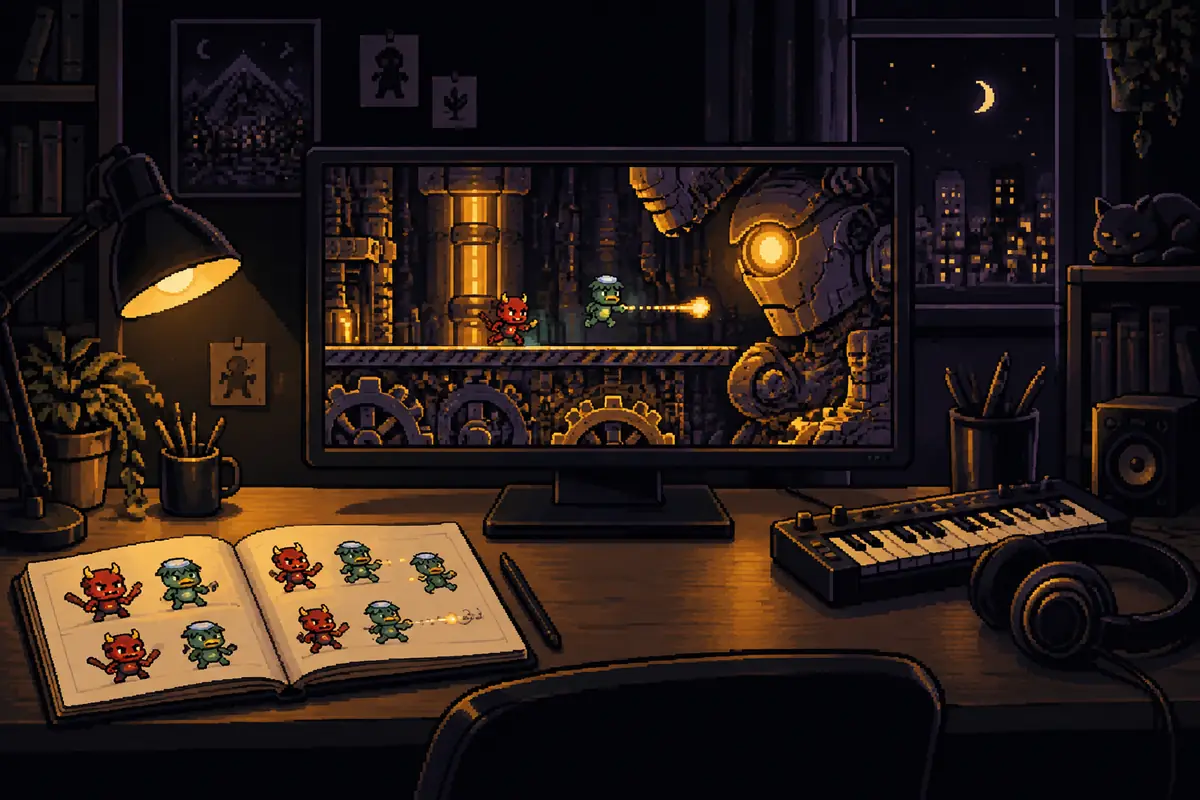
- It's a short side-scrolling action game: the player switches between an ogre and a kappa, two creatures from Japanese folklore, until reaching a robot boss.
- Claude Code and OpenAI Codex wrote the code. Art, music, rules, tuning and testing stayed with him, with no AI in the images or the sound.
- He advises starting small, with simple rules like those of an 8-bit console game, in a kind of game you already like.
Your first step: Pick the kind of game you like most and write down what a single level of it would look like, with just one rule, as Takakura recommends.
Who is Kazuki Takakura?
Kazuki Takakura is a Japanese artist, born in 1987 in Yamanashi Prefecture, with a graduate degree from Tokyo Zokei University2. He works with pixel art (drawings made dot by dot, like in old console games), games, virtual reality and AI, and has exhibited in Japan, Taipei, New York and Mexico2.
He has been drawing, making music and inventing rules and worlds for a long time1. Coding, no. According to him, he has no programming knowledge and, even with the game finished, still finds it strange that writing text makes things move on the screen1.
Until then, he had only made games as part of a team1. Every change depended on money and on other people's approval. What he wanted, he says, was to make games with the same freedom he has when he makes a drawing1.
How do you play Onikappa?
Onikappa is a short action game seen from the side, in which the screen scrolls as the character moves1. The player switches between two creatures from Japanese folklore: an ogre (oni) and a kappa, a water creature1. Each has different abilities, and the game has shooting, in the style of Mega Man, a console classic1.
The level takes place inside the body of a giant of knowledge, the "Descartes Machine", a robot inspired by Western philosophy2. The player explores, faces enemies and reaches the boss. Collect the four philosophy plates scattered along the way, and the boss gets weaker1.
The full name is "Onikappa to Chi no Kyojin - 001_Descartes Shinkami", something like "Ogre, Kappa and the Giant of Knowledge". It's the first level of a series, released on its own; the next ones are expected to come out as separate games2.
How did he make the game with AI?
AI wrote all of the code; the rest was his. Takakura used two AIs that work inside the project folder, Claude Code and OpenAI Codex1. He describes the split as a small team1:
| Role | Who did it |
|---|---|
| Direction, art, music and final decision | Takakura1 |
| Programming, planning, bug hunting and project notes | AI1 |
According to the report by the Japanese site KAI-YOU, he made the graphics, the music, the rules, the tuning and the testing, and did not use AI to generate images or sounds2. The game's itch.io page says the same: the AI disclosure marks only the code3.
The idea he is proudest of came from the artist's side. Instead of marking, one by one, the walls and floors the character steps on, he paints those areas with colors on an image, and the game reads the painting1. He calls it a "collision paint system" and says it was the project's biggest invention1.
Why didn't he let AI decide the game?
Because, for him, what makes a game fun depends on the body. The feel of the controls, the difficulty and what is fun are decided by playing, and AI has no body to feel that1. Left on its own, he says, AI tends to produce an expression that represents the average of the audience1.
Our reading: it's the same division of labor seen in other cases, like Curve Clash: AI does the technical part, and the person making the game keeps deciding what it is. When you don't decide, AI fills the gap, and it fills it with the most common answer. This also shows up in what vibe coding is.
When and where did the game come out?
On May 17, 2026, on itch.io, a store for independent games, playable in the browser2. The final version had been finished one day earlier, on May 161. In October 2026, the itch.io page listed the game as free, with a button to support the author3. It's also on the website of his studio, STUDIO TOKOYO4.
The game was shown for the public to play at the exhibition "NEW MEDIA / NEW TECHNOLOGY / NEW ARTIST", at Artist Cafe Fukuoka, from May 23 to June 7, 20262. In July, Takakura published a long account of how he made the game; the first part is free, and the rest is paid1.
By the numbers
| Data | Value | Source |
|---|---|---|
| Year of birth | 1987 | KAI-YOU, 05/24/20262 |
| Final version finished | 05/16/2026 | Author's account, 07/16/20261 |
| Release on itch.io | 05/17/2026 | KAI-YOU, 05/24/20262 |
| AIs used | 2 (Claude Code and OpenAI Codex), code only | Author's account1 and itch.io3 |
| Plates that weaken the boss | 4 | Author's account1 |
| Exhibition in Fukuoka | 05/23 to 06/07/2026 | KAI-YOU, 05/24/20262 |
| Production time, players and revenue | Not disclosed |
What does he advise people who are starting out?
Start small, in a kind of game you already like, according to him1:
- One level only. A small game gets finished; a big one stalls on the art and on complicated rules.
- Simple rules, like those of an 8-bit console game. A beautiful 3D game is hard to finish with AI.
- A game that runs in the browser, which is quick to test.
- Avoid games that depend on exact timing, like rhythm and fighting games.
- Keep the feel of the controls for yourself. It's the part AI can't feel.
He also points out that a game isn't good just because it's beautiful and expensive to make1. To get to that first small level, see how to start making a game.
The other side
Takakura is not a beginner at games: he's a professional artist with years of exhibitions, who had already made games as part of a team and already knew how to draw and compose. AI took the coding off his hands, not the rest of the work. His account doesn't say how long the game took, how many people played it or whether it made any money, and he says he's still looking for a company to distribute the next ones. The story proves you can make and release a game without coding, not that it's easy or that it makes money.
What does this story change for people who don't code?
Our reading: Takakura's story shows that people who already have a talent outside programming, like drawing, writing or composing, can now carry that talent all the way to a complete game. The barrier that used to require a programmer on the team is now handled by AI. The part that gives the game its identity stays with you.
To see other cases, of people who already coded and people who didn't, see who has made a game without being a programmer.
Related questions
Who is Kazuki Takakura?
A Japanese artist born in 1987 in Yamanashi, with a graduate degree from Tokyo Zokei University. He works with pixel art, games, virtual reality and AI, and has exhibited in Japan, Taipei, New York and Mexico.
Can Kazuki Takakura code?
No. According to him, he has no programming knowledge and still doesn't understand how code makes things move. AI wrote all of the game's code.
Which AI did he use?
Claude Code and OpenAI Codex, both to write the code. According to KAI-YOU's report, he did not use AI to generate images or sounds.
Where can you play Onikappa?
In the browser, on the game's itch.io page and on the website of his studio, STUDIO TOKOYO. In October 2026, the itch.io page listed the game as free, with an option to support the author.
How do you play Onikappa?
It's a short action game seen from the side. The player switches between an ogre and a kappa, each with different abilities, crosses a large level, faces enemies and a robot boss, which gets weaker if the player collects four plates along the way.
How long did it take him to make the game?
His account doesn't say. The final version was finished on May 16, 2026, and the game came out the next day.
What kind of game does he recommend for starting with AI?
A small game, one level, with simple rules like those of an 8-bit console game, in a kind of game you already like. He advises against games that depend on exact timing, like rhythm and fighting games.
Sources
- Kazuki Takakura, account on note about the game made with AI (07/16/2026). Accessed October 25, 2026.
- KAI-YOU, report on the release of Onikappa (05/24/2026). Accessed October 25, 2026.
- itch.io, game page for Onikappa - 001_Descartes Shinkami. Accessed October 25, 2026.
- STUDIO TOKOYO, games page. Accessed October 25, 2026.
Was this article helpful?
Thank you. This helps us decide what to improve.
Once a week, what changed in making games with AI
Every Tuesday, a 3 to 5 minute read: the news that changes something for people who want to make a game, one reader question answered, and the new articles. Unsubscribe anytime with one click.
By signing up, you agree to the privacy policy.
Done. We sent you an email to confirm.
That didn't work. Check that your email is correct and try again.
Found a mistake? Let us know. We fix it and log the correction on the page. Report a mistake