
Start here
Is making a game with AI easy? What still takes work
A 2026 test: the best AI solved just over half the tasks of making a game. Here is where it stumbles.
SUMMARY FOR WHEN YOU'RE SHORT ON TIME · 2 min
It is not easy, but it became possible for people who do not code. AI writes the code and assembles the parts of the game, but in a 2026 academic test, the best model solved only 53.8% of 333 game tasks on its own. You still have to decide what the game is, test whether it is fun, find what the AI broke, and get people to play.
- In GameDevBench, a test presented at the ICML 2026 conference, the best AI solved 53.8% of 333 game tasks built in Godot on its own.
- In the same test, the AIs got an average of 51.4% of gameplay tasks right and 33.0% of 2D graphics tasks.
- When the request was to make the entire game, the best AI in another 2026 test reached 41.46%, and most stayed below 40%.
- AIs are better at setting up the foundation of a game than at finding bugs and not breaking what already worked, according to a third test.
- The Claude Code documentation warns that in a long conversation the AI can forget instructions, and that it stops when the work looks done.
- Jonathan Bjerk, a Norwegian accountant who knew only a little HTML, published a game made with AI in less than seven months; the hardest parts, he says, were the online mode bugs and marketing.
- In Japan, 85.8% of 1,349 game professionals surveyed by the industry association use AI at work; worldwide, 52% of those surveyed by GDC see it as negative for the industry.
Your first step: Write down on a sheet of paper the three decisions only you can make about your game: what the player does, how they win, and what stays out of the first version.
Is making a game with AI easy?
It is not easy. It became possible for people who do not code, which is a different thing. AI cleared away the part that stopped most people, writing the code, and left in plain sight the parts that were always hard in any game.
| What got easier with AI | What still takes work |
|---|---|
| Writing the code | Deciding what the game is, and what stays out |
| Getting a first version that runs | Finding the bugs the AI does not notice |
| Carrying out a clear, well-described request | Keeping one change from breaking what already worked |
| Building familiar parts, like jumping, scoring, and menus | Getting the feel of play and the visuals right |
| Putting the game in a store and getting people to play |
Our take, based on the tests and real cases on this page.
If you do not yet know what working with AI is like, start with can you make a game without knowing how to code?. This page goes deeper into the hard part.
What did the 2026 test show about AI making games?
It showed that the best AI, working alone, solved just over half the tasks. The test is called GameDevBench, and it was published in the proceedings of ICML 2026, an academic machine learning conference1.
The researchers took 333 tasks from game tutorials, in text and video, all in Godot, a free program for making games12. The best combination, Google's Gemini 3 Pro with access to screenshots and videos of the game running, solved 53.8% of them2.
The test also showed where AI stumbles most. The average success rate dropped from 51.4% on gameplay tasks (what the player does, and the rules) to 33.0% on 2D graphics tasks, such as art, animation, and visual effects. And the solutions required more than three times as many lines of code and files changed as the programming tests that came before it1.
One finding helps explain the role of whoever tests the game: when the AI could see the screen and the game running, it improved. OpenAI's GPT-5.4 went from 41.1% to 52.0% with that visual feedback1. In other words, AI makes fewer mistakes when someone, or something, shows it what came out (our take).
Two other 2026 tests, released as preprints on arXiv, a repository of scientific papers, point the same way:
| Test | What it asked for | Result | Source |
|---|---|---|---|
| GameDevBench (ICML 2026) | 333 game tasks in Godot | The best AI solved 53.8% | Chi et al.1 |
| GameCraft-Bench (June 2026) | 140 tasks to make a game, across 15 genres, in Godot | The best AI reached 41.46%; most stayed below 40% | Luo, Wang et al.3 |
| GameXpert-Bench (August 2026) | Creating, fixing, and improving games over several rounds | Better at setting up the foundation; worse at finding bugs and not breaking what worked | Chen et al.4 |
These numbers are a snapshot of 2026. The AIs tested already have newer versions, and the results are likely to change. The tests measure AI alone, in one attempt, with nobody steering, which is exactly what does not happen in a real game.
What does AI do well in a game?
AI is good at building the foundation: the first version that runs, with the rules you described. GameXpert-Bench says AIs are more reliable at producing a playable base and carrying out explicit requests4. GameCraft-Bench says they usually get the recognizable parts of each type of game right3.
The cases of people who did not code confirm this. Japanese artist Kazuki Takakura says all the code of his game, a 2D action game, was written by AI, using OpenAI's Codex and Anthropic's Claude Code. He says he still does not understand programming8.
Jonathan Bjerk, an accountant from Norway, says a problem that took him a month to solve in June 2025 now takes him two days, thanks to what he learned and, above all, to newer tools7.
Where does AI still fail?
It fails where you need to look at the game running: finding the bug, checking that everything works, and not wrecking what was already done. GameXpert-Bench points to exactly these three weaknesses4.
GameCraft-Bench adds polish. AIs struggle to deliver games with enough content, with visual feedback that works (the player noticing they hit, missed, or won), and with a coherent presentation3.
The Claude Code documentation itself, for Anthropic's coding AI, warns about two behaviors5:
- It forgets in long conversations. When the conversation fills up, the AI may start forgetting earlier instructions or making more mistakes.
- It stops when the work looks done. Without a way to check, "looks done" is the only signal it has, and you become the one who checks everything. The common failure is work that looks right but does not handle the unusual cases.
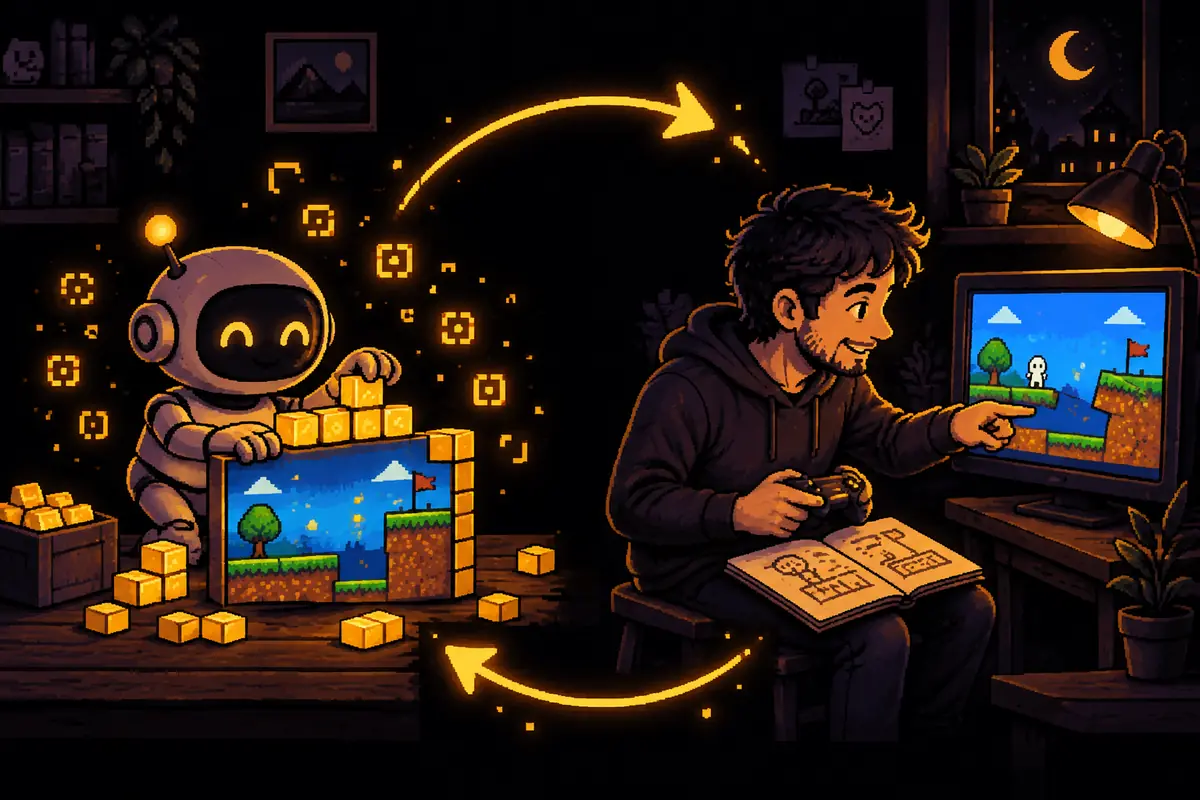
In practice, this becomes a loop. The AI builds, you play, you point out what went wrong, and it redoes it. The loop works, but every round is your work, and this is where most of the time goes (our take).
What is still your job?
Four things stay with whoever makes the game: deciding, testing, publishing, and marketing. AI helps with all of them, but does none of them for you.
Deciding. Kazuki Takakura lists what, for him, are human decisions: whether the game is fun, the art direction, how tough the bosses are, the feel of the controls, and the satisfaction of clearing a level. According to him, when AI decides these things, the game tends to come out mediocre8.
Testing. Bjerk spent hours playing and adjusting values like the turning speed and the thickness of the trail left by the snake in his game. For him, AI cannot tell whether the game is fun; other people can7.
Publishing. Stores have their own rules, and AI does not skip them. On Google Play, for example, a personal account created after November 13, 2023, must run a closed test with at least 12 people for 14 days in a row before launching9. Bjerk says the store page, the promotional images, the translation, and the servers took a lot of time7.
Marketing. Bjerk says marketing was harder than making the game. He reached out to more than a thousand video creators on TikTok for a tournament of his game7. The competition is fierce: Steam, the largest store for computer games, received about 20,000 new games in 2025, according to the trackers cited by Chris Zukowski, author of the site How To Market A Game10.
How did it go for people who tried?
Three real cases show the same obstacles along the way.
The game that worked and turned out bad. In April 2026, the team of the podcast What Next: TBD, from the American magazine Slate, decided to test on the show whether AI coding tools work or are just hype. The host, Lizzie O'Leary, and producer Patrick Fort had never programmed; producer Evan Campbell had a little experience6.
With Claude Code, they made a game described as a version of the classic The Oregon Trail about making a podcast. The game worked. But Slate's vice president of technology did not want to put it on the magazine's website, over security concerns, and it was published on the producer's personal site. In the story's headline, they call the game bad themselves6.
The accountant who published. Jonathan Bjerk, a 38-year-old Norwegian accountant, knew only HTML and CSS, self-taught to build simple websites. He started Curve Clash, a multiplayer snake game, on May 28, 2025, using ChatGPT, then Cursor, and finally Claude. He launched a test version in August and the full version in mid-December, without quitting his job7.
The road was not smooth. Sync bugs in the online mode stalled the work in September and October 2025. According to him, more than 1,500 people played. Summing up his own role, he said AI was his engineering team, not his creative director7.
The artist who made his own game. Kazuki Takakura, a Japanese artist, did all the art and sound for a side-scrolling action game himself and left the code to AI. The game was finished on May 16, 2026, and runs in the browser8.
All three give similar advice. Bjerk recommends starting with a single-player game, cutting without mercy anything that is not essential, and getting people to test early7. Takakura recommends a small, one-level project, as simple as NES games, and avoiding rhythm and fighting games, which require precise timing8.
Do game professionals think AI made it easier?
They use it a lot and distrust it at the same time. The two numbers come from different surveys and should not be compared as if they were the same measure.
| Survey | Who answered | Uses AI at work | The other side |
|---|---|---|---|
| CESA, the Japanese association of game companies (preview of September 17, 2026) | 1,349 professionals in Japan, including teachers and students | 85.8%; 63.0% every day | The association warned about copyright problems11 |
| GDC, State of the Game Industry 2026 | More than 2,300 game industry professionals | 36% | 52% see AI as negative for the industry, up from 30% the year before12 |
In the GDC survey, programmers are among the most skeptical: 59% see AI as negative12. People who already knew how to do the work use the tool and, at the same time, see its risks. For someone who has never made a game, the same tool is what makes starting possible, but the work of deciding and checking that these professionals know so well is still there (our take).
So is it worth trying?
It is, if you go in knowing where the work is. AI removed the biggest barrier, which was programming, and left the rest: deciding, testing, publishing, and marketing (our take).
Three choices shrink the hard part, and all of them show up in the cases above: a small, single-player game with no online mode; real people playing from the first version; and an idea written down before you open any program. If you are still at the beginning, see how to take the first step before opening any program and what vibe coding is, the name this way of building software by talking to AI has come to be known by.
The other side
Making a game with AI is not easy, and this page promises no timeline and no result. The 2026 tests measure AI alone and have already been overtaken by newer versions, for better or worse. The real cases are few, their numbers are self-reported, and none shows there is money in it: the Slate game turned out bad, and Bjerk still works as an accountant. In the GDC survey, more than half of professionals see AI as negative, and some players are wary too. What changed is that not knowing how to code is no longer the end of the conversation.
Your action plan
Check off what you've done. It's saved on this device, so you can pick up where you left off.
Related questions
Is it easy to make a game with AI?
It is not easy, but it became possible without coding. In a 2026 academic test, the best AI solved 53.8% of 333 game tasks on its own. The rest depends on someone deciding, testing, and fixing.
Can AI make a whole game by itself?
Not with quality yet. In a 2026 test where the request was the complete game, the best AI reached 41.46%. It usually gets the main idea right and fails at content, visual feedback, and polish.
What is the hardest part of making a game with AI?
It depends on the game, but real cases keep repeating three things: finding and fixing bugs the AI does not notice, tuning the feel of play, which you only get right by playing, and getting people to know the game exists.
Why does AI break things that already worked?
2026 tests show that AIs are worse at preserving what worked across several changes than at building the foundation. In long conversations, the Claude Code documentation itself warns that the AI can forget instructions.
Do game professionals use AI?
Many do. In Japan, 85.8% of the 1,349 professionals surveyed by CESA said they use generative AI at work. In GDC's 2026 global survey, the figure was 36%, and 52% think AI is bad for the industry.
Is a game that works a good game?
Not necessarily. In 2026, the team behind a Slate podcast made a game with AI that worked, and they themselves called it bad in the headline of their story.
How long does it take to make a game with AI?
Nobody can promise a timeline. Jonathan Bjerk, who did not code, took less than seven months, while working full time as an accountant, to publish his game. A smaller game tends to take less (our take).
Sources
- GameDevBench, Chi et al., ICML 2026 proceedings. Accessed October 14, 2026.
- GameDevBench, full text on arXiv (version of June 30, 2026). Accessed October 14, 2026.
- GameCraft-Bench, Luo, Wang et al., arXiv (June 16, 2026). Accessed October 14, 2026.
- GameXpert-Bench, Chen et al., arXiv (August 22, 2026). Accessed October 14, 2026.
- Claude Code documentation, "Best practices". Accessed October 14, 2026.
- Slate, the AI-made game by the team of the podcast What Next: TBD (April 5, 2026). Accessed October 14, 2026.
- AI Gamechangers, interview with Jonathan Bjerk (April 6, 2026). Accessed October 14, 2026.
- Kazuki Takakura, post on note about the game Onikappa (July 16, 2026). Accessed October 14, 2026.
- Google Play Console, testing requirement for new personal accounts. Accessed October 14, 2026.
- How To Market A Game, Chris Zukowski, games released on Steam in 2025 (January 8, 2026). Accessed October 14, 2026.
- gamebiz, preview of the CESA 2026 report on generative AI (September 18, 2026). Accessed October 14, 2026.
- GDC, "State of the Game Industry 2026". Accessed October 14, 2026.
Was this article helpful?
Thank you. This helps us decide what to improve.
Once a week, what changed in making games with AI
Every Tuesday, a 3 to 5 minute read: the news that changes something for people who want to make a game, one reader question answered, and the new articles. Unsubscribe anytime with one click.
By signing up, you agree to the privacy policy.
Done. We sent you an email to confirm.
That didn't work. Check that your email is correct and try again.
Found a mistake? Let us know. We fix it and log the correction on the page. Report a mistake