
Start here
How to make a game in your spare time, with a day job
Minecraft was born while its creator still had a job. See where a game fits in the week of someone who works, and what AI changes in that math.
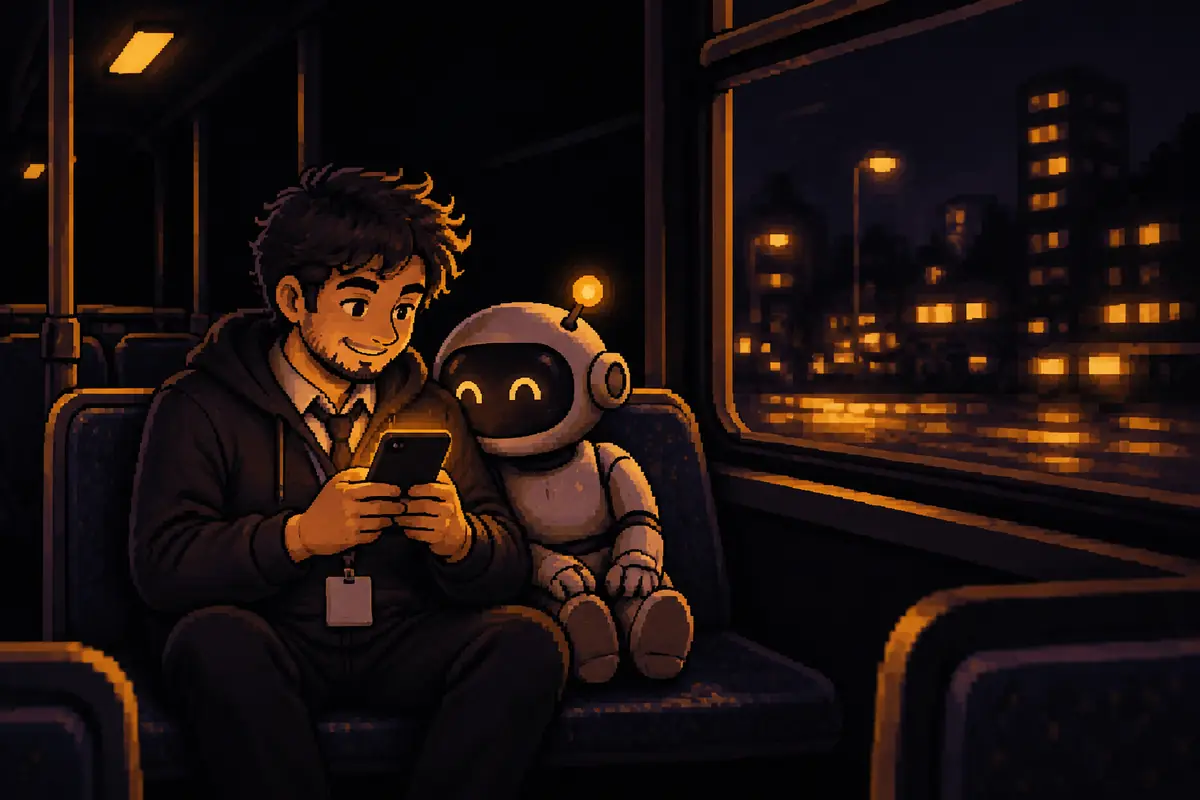
SUMMARY FOR WHEN YOU'RE SHORT ON TIME · 2 min
You can make a game with a day job, but slowly. Minecraft, Cave Story, and Balatro started while their creators were employed, took years, and were made by people who already programmed. With AI, the routine changes: it can work on your home computer while you work, and you follow it on your phone. The computer must stay on, and the AI's entry plan has a usage limit.
- Minecraft's creator kept his programming job while making the first version of the game, released in May 2009; the game was only finished in November 2011.
- Cave Story was made by one person, in his free time, over five years; the author started in college and kept going after becoming a programmer.
- Balatro's author started the game as a side project in 2021 and only quit his job about a year before the release, in 2024.
- Norwegian accountant Jonathan Bjerk, with a full-time job, released a game made with AI in under seven months.
- With the Claude app on your phone, you can steer the AI working on your computer, as long as the computer stays on and the program stays open.
- Claude's entry plan, $20 a month in October 2026, has a usage limit that resets every five hours and a weekly limit.
- No serious source says how many hours a week are enough: the size of the game matters more than the tool.
Your first step: This week, write down the real breaks you have: lunch, the commute home, the evening. Add up how many hours they make, not counting the weekend.
Can you make a game with a day job?
Yes, and plenty of people have. What does not work is waiting for a free month that never comes. The well-known cases have two things in common: they started while the author had a job, and they took years.
The scene is a familiar one. You get home from work, look at the computer, and think that making a game requires a vacation, or at least a whole weekend. But almost none of the games on this page were born that way. They were born in off-hours, over years.
With AI, part of that math has changed. AI writes the code, which is the set of commands that makes the game work, from what you describe. And it can work on your home computer while you are at your job. What stays with you is deciding what the game is, testing it, and saying when it is good. See what takes time in a first game.
Who has made a game without quitting their job?
Several well-known games started that way, all made before AI. Before the table, three warnings: almost all the authors already worked in programming or games; all of them took years; and these are cases that worked out among thousands that almost nobody played.
| Game | How it was made | How long | Source |
|---|---|---|---|
| Minecraft | The author, a programmer, kept his job while making the first version | First version in May 2009, game finished in November 2011 | Wikipedia12 |
| Cave Story | One person, in his free time, starting in college and continuing after becoming a programmer | Five years, until 2004 | Wikipedia3 |
| Thomas Was Alone | A professional game designer, in his off-hours, with the blessing of the studio where he worked | From the idea, in 2010, to the release, in June 2012 | Wikipedia4 |
| Gunpoint | A game magazine editor, with no formal background in programming, in his spare time | From May 2010 to June 2013 | Wikipedia5 |
| Balatro | One person alone, as a side project, who only quit his job about a year before release | About two and a half years, until February 2024 | Wikipedia6 |
| Curve Clash | A full-time accountant, with AI | Under seven months, from May to December 2025 | AI Gamechangers7 |
Minecraft is the most famous case. It is a game where the whole world is made of blocks: you break them, collect them, and build, and at night monsters show up, so it is good to have a house. There is no required goal2. Markus Persson, the author, already worked as a programmer and kept his job while making the first version. In 2010 he went part time, and he left the company later that same year1.
Cave Story is the longest case. Daisuke Amaya started the game in college and kept going after getting a job as a programmer. He made the code, the art, the story, and the music himself, in his free time, over five years3.
Gunpoint is the closest to someone from outside the field. Tom Francis was an editor at the British edition of PC Gamer magazine and had no formal background in programming. He made the game in his spare time, with a program that cost $30, and only after the release did he leave the magazine to make games5. Even so, it took three years.
What these cases prove is that you can start with a job. They do not prove it is fast, and none of them was made with AI.
And with AI, has anyone done it with a job?
Yes, and the best-documented case is Curve Clash. Jonathan Bjerk is an accountant in Norway, was 38, and still works full time. As for programming, he knew only the basics for building simple web pages7.
He started the game on May 28, 2025, with AI. In August, he had a test version. By mid-December, the game was published on the web, iPhone, Android, and Mac: under seven months, without quitting his job7. The interview does not say at what time of day he worked on the game, so that part goes unanswered.
But the path was not straight. Bjerk spent September and October stuck on bugs in the mode where several people play together7. And, according to him, the hardest part came after it was finished: getting people to discover the game7. The full story is in Curve Clash, the accountant who released a game made with AI.
How does AI work while you are at your job?
It works on your computer, and you follow along on your phone. In Claude Code, the AI that writes the code inside the game's folder, this has a name: Remote Control8.
Here is how it works: the AI runs on your home computer, with the game's files. The Claude app, on iPhone or Android, becomes a window into that session. You can send requests, answer the AI's questions, and follow what it is doing89. You can even send a photo, such as a level drawn on paper8.
Three details matter for someone who works away from home:
- The computer has to stay on, with the program open. If you close the program, the session goes offline until it is opened again8.
- If it sleeps or the internet drops, the connection comes back on its own when the machine wakes up8.
- Your phone tells you. With Remote Control active, the AI can send a notification when it finishes a long task or when it needs a decision from you9.
There are also cloud sessions: the AI works on Anthropic's computers and keeps going even with yours turned off. The condition is having the project stored on GitHub, a site that stores the files of programs9. Remote Control is available on the paid Pro, Max, Team, and Enterprise plans8.
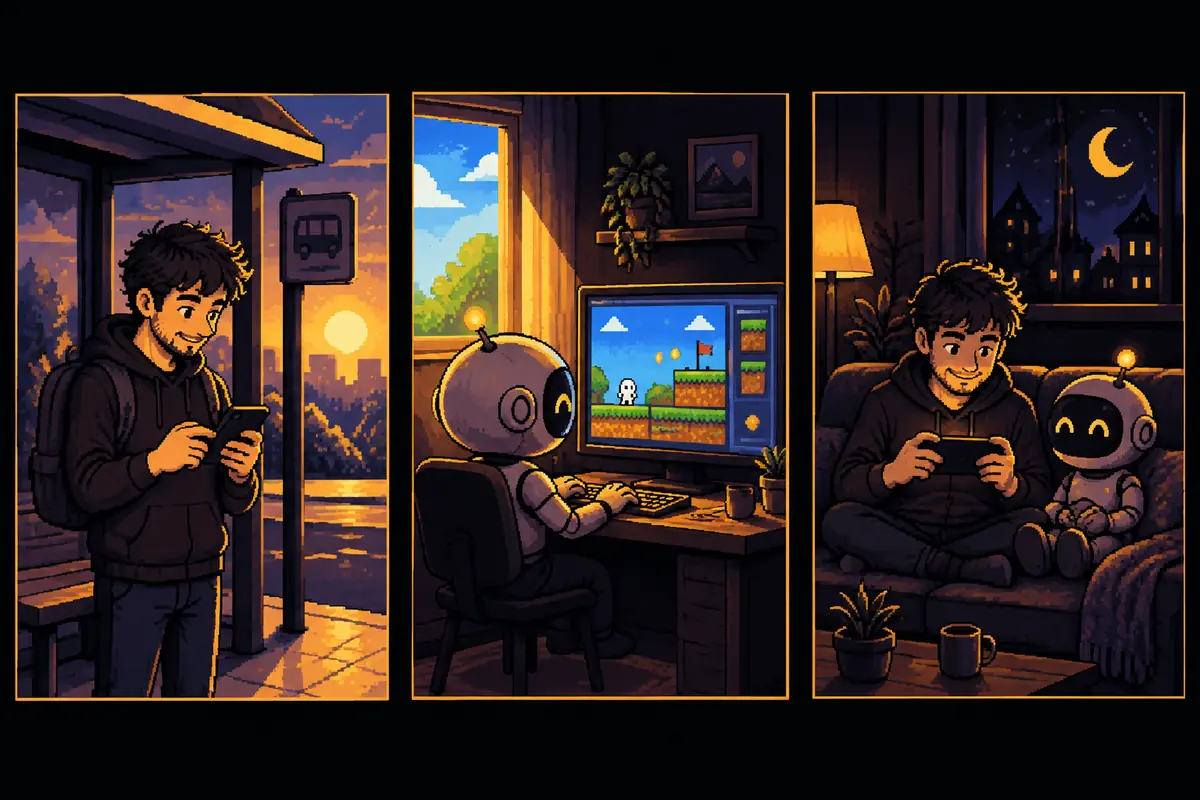
What changes in the routine is the shape of the time (our reading). Before, making a game required a block of hours in front of the computer, writing code. Now the work can be split into short requests throughout the day, with the AI working between them, and a longer stretch at night to play the new version and decide what changes.
Can you do it on your phone, during work breaks?
You can run a good part of it from your phone, as long as the work happens on a computer that is on. That is how Daniel Novi, who writes this site, makes his games. In his words: "I make games on my phone, during work breaks, with the computer on at home doing the work."
Two honest warnings about this approach. The first: the phone is the remote, not the place where the work happens. Without the home computer on, or without the cloud, there is nothing to steer. The details are in can you make a game with AI using only your phone.
The second: Daniel uses the AI's top plan, because he makes several large games at the same time. The entry plan does not sustain that pace. And none of his games has been published yet.
How many hours a week do you need?
No serious source gives that number, and making one up would be a guess. What the cases show is that the size of the game matters more than the hours: a big game, with little time, turns into years.
What you can do is the math in reverse (our reading). First, find out how many hours you really have, counting the short breaks and the evening. Then, choose a game that fits in them. A game with one screen and one action, like tapping to jump, fits a small amount of time much better than a world to explore. The types that fit are in what your first game should be.
There is also a limit that does not depend on you: the AI's. Claude's entry plan costs $20 a month, or $17 a month on the annual plan, with $200 paid up front (prices as of October 2026). The usage limit resets every five hours, and paid plans also have a weekly limit10. When it runs out, you wait to continue. For someone with little time, that can coincide with the only free hour of the day. The Max plan starts at $100 a month, with five or twenty times Pro's usage10.
What gets in the way most when you make games in your spare time?
The size of the game, above all. Every extra level, character, or mode is one more thing to make, test, and fix, and with few hours a week that multiplies.
Bjerk, who made his game while holding a job, left four pieces of advice7:
- Do not start with a game for several people over the internet. First, make the game good for one person. That is where he spent two months stuck.
- Do not switch AI tools all the time. Each switch cost him adjustment time.
- Cut ruthlessly. Everything that goes into the game needs maintenance, fixing, and tuning.
- Get people testing early. In his words: "AI can't tell you if your game is fun. Other humans can."
In our reading, there are two more. Changes of plan midway, which redo what was already finished, weigh more on someone with little time. And fatigue: after a day of work, the hard decision gets pushed to tomorrow. That is why it helps to write down, beforehand, what the game is and what stays out.
The other side
Making a game in your spare time is possible, and it is neither fast nor light work. The famous cases on this page took from two and a half to five years, were made before AI and, almost all, by people who already worked in programming or games. Curve Clash was faster, with AI, but it is a single case, and the author says getting people to know the game was the hardest part. Steering the AI from your phone requires a computer left on at home or the project in the cloud, and a paid plan, with a usage limit. And finishing a game does not mean it will make money.
How do you start this week?
With the time you already have, without waiting for a vacation. The first step does not even need a program: write your game idea in three sentences, during your lunch break, and cut it down until it fits on one screen with one action.
Your action plan
Check off what you've done. It's saved on this device, so you can pick up where you left off.
Related questions
Can you make a game while working all day?
Yes, and there are well-known cases: Minecraft, Cave Story, Thomas Was Alone, and Gunpoint started while their authors had jobs. All of them took years, and were made before AI, almost all by people who already worked in programming or games.
How many hours a week do I need to make a game?
There is no reliable number. The time depends on the size of the game and on changes of plan more than on the hours. A game with one screen and one action fits a small amount of time better than a world to explore.
Can I make a game on my phone, during work breaks?
You can steer the AI from your phone, but the work happens on a computer left on at home or in the cloud. With Claude Code's Remote Control, the computer has to stay on and the program open.
Does the AI work while I am at my job?
It can, if the computer stays on with the session open. The app can send a notification to your phone when a long task finishes or when the AI needs a decision from you. It does not decide on its own whether the game is good.
Do I need to quit my job to make a game?
No. Balatro's author only quit his job about a year before the release, after more than a year of working on it on the side. Jonathan Bjerk released Curve Clash while working full time as an accountant.
Is the AI's entry plan enough for someone with little time?
To start a small game, yes. The usage limit resets every five hours and there is a weekly limit; when it runs out, you wait. Someone making several large games at the same time needs a bigger plan.
Sources
- Wikipedia, "Markus Persson". Accessed October 15, 2026.
- Wikipedia, "Minecraft". Accessed October 15, 2026.
- Wikipedia, "Cave Story". Accessed October 15, 2026.
- Wikipedia, "Thomas Was Alone". Accessed October 15, 2026.
- Wikipedia, "Gunpoint (video game)". Accessed October 15, 2026.
- Wikipedia, "Balatro". Accessed October 15, 2026.
- AI Gamechangers, interview with Jonathan Bjerk (April 6, 2026). Accessed October 15, 2026.
- Claude Code documentation, "Remote Control". Accessed October 15, 2026.
- Claude Code documentation, "Claude Code on mobile". Accessed October 15, 2026.
- Anthropic, Claude pricing page (prices as of October 2026). Accessed October 15, 2026.
Was this article helpful?
Thank you. This helps us decide what to improve.
Once a week, what changed in making games with AI
Every Tuesday, a 3 to 5 minute read: the news that changes something for people who want to make a game, one reader question answered, and the new articles. Unsubscribe anytime with one click.
By signing up, you agree to the privacy policy.
Done. We sent you an email to confirm.
That didn't work. Check that your email is correct and try again.
Found a mistake? Let us know. We fix it and log the correction on the page. Report a mistake